When a supplier is breached, can you see the blast radius?
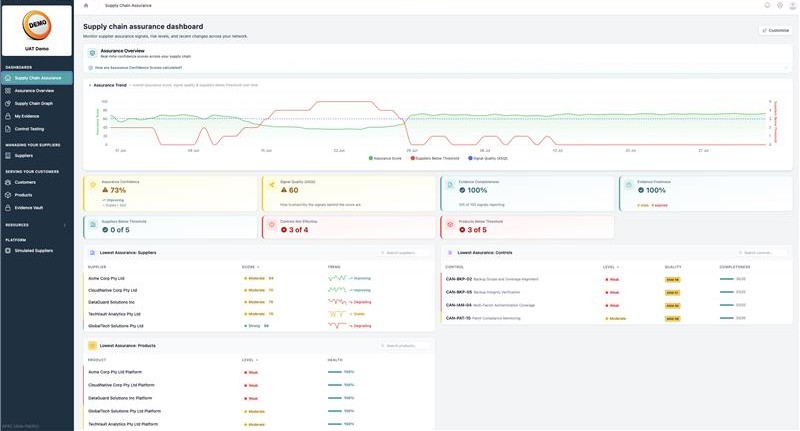
Supply states the condition of your controls in both directions. Your own posture, and the third and fourth parties you depend on. One standard, one record, dated throughout.
Point in time assurance leaves you reading last year.
The snapshot
A questionnaire answered in March describes March. Risk moves between reviews, and the record does not.
The blast radius
When an incident lands on a fourth party you did not know you relied on, the dependency map does not exist to read.
The paperwork
Chasing, completing and filing attestations consumes the team without changing the condition of a single control.
Start with your own house, stated today.
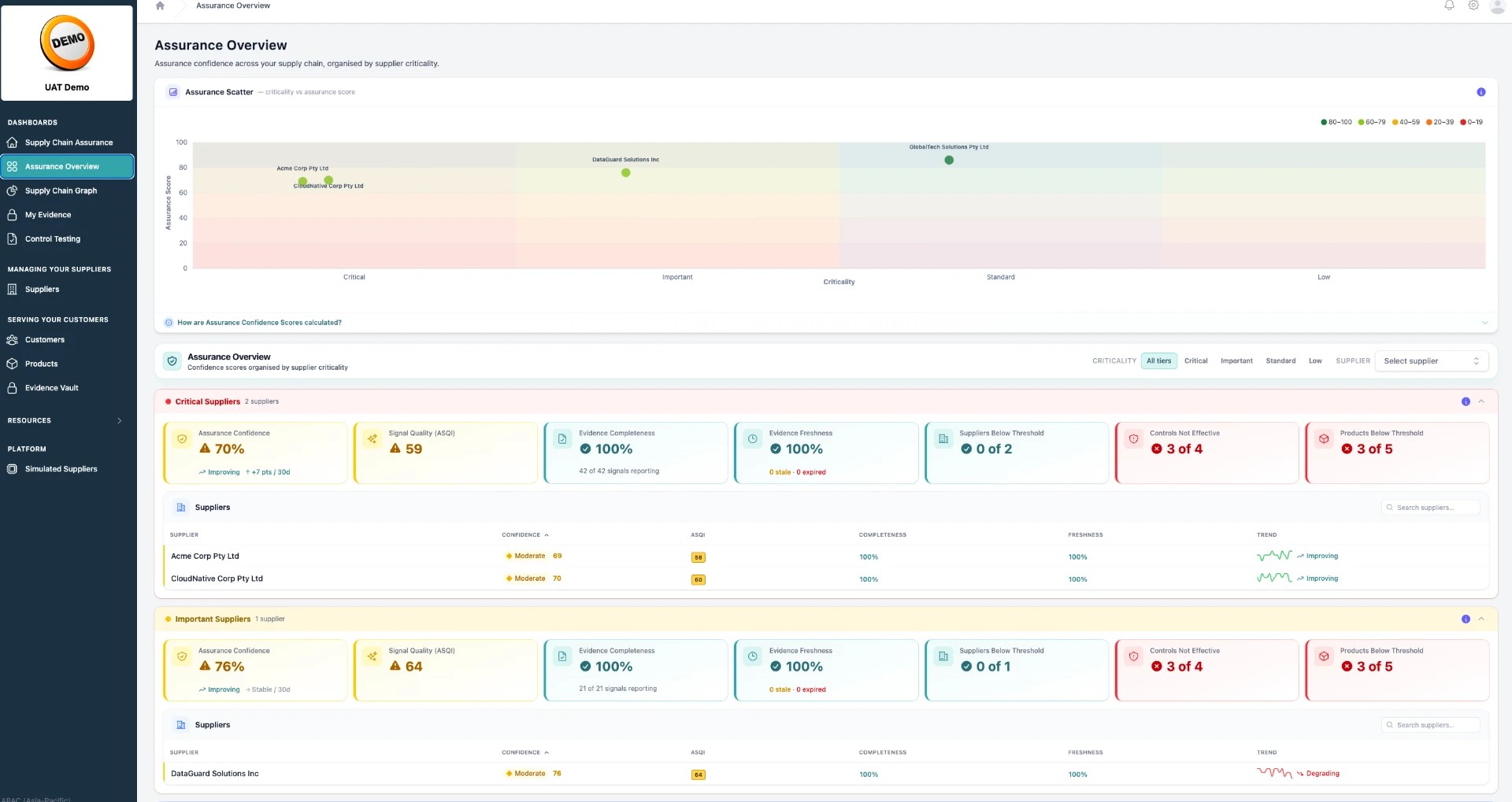
Supply does not only look outward. Connect it to your own systems and it holds a continuous view of your compliance, control by control, against the frameworks you map. ISO 27001, CPS 234 and the rest. Not the certificate from last year's audit, but the condition of the control today, with the date attached.
Certification is a moment. The day after the audit a configuration changes, a certificate expires, a new system appears, and most organisations do not learn of it until the next review. Supply watches for exactly that and moves the state from Current to Ageing to Lapsed as the evidence ages, so the gap is visible when it opens rather than months later.
Because you already hold that record, you can share it. Your inward assurance becomes the profile you present to the customers who assess you. Prove it once, share it with many.
Walk into an audit already evidenced.
No surprise from drift between reviews.
A board that reads a condition, not a certificate.
Click one supplier. See everything it touches.
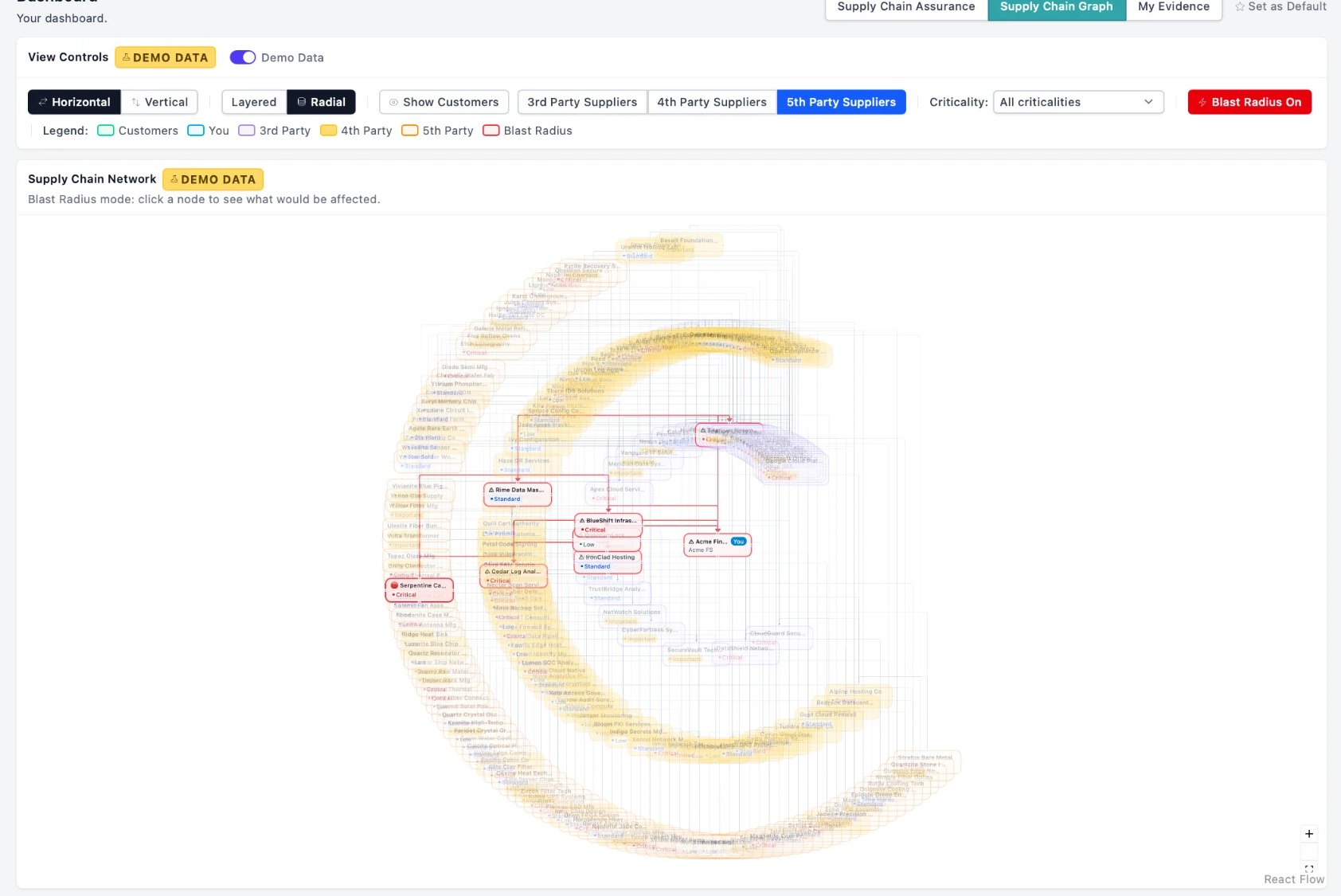
Testamark holds the dependency graph across third, fourth and fifth party tiers. When an incident lands, blast radius mode traces the path from the affected node to every product, control and customer obligation that depends on it, in the time it takes to click.
Trace to five tiers
Concentration risk you did not know you carried, drawn as a graph rather than a spreadsheet.
Impact before urgency
Read which of your own products and customers sit downstream of the failure.
Dated throughout
Every node carries its own assurance state and the date the evidence was last read.
One continuously assessed network.
Invite your suppliers, and their suppliers, into a single assessed network at no cost to them to share attestations which they do now individually, and allow them to upload once and share everywhere. Then uplift them towards the future of live signals and integrations.
Tier visibility
Third and fourth party dependencies mapped, so impact is legible before it is urgent.
Prove once, share with many
A supplier evidences their controls a single time and every customer on the network reads the same dated record.
Comparable by construction
Every relationship is stated at a declared depth, so two suppliers can honestly be compared.
As much assurance as the consequence demands.
Every relationship is held at a declared depth, and the depth is visible on the record. Start where you and the supplier already are, then move closer to observed where a lapse would hurt most.
- D1
Declared
The organisation states the control is in place. Useful for low consequence relationships, and honest about what it is.
- D2
Evidenced
The statement is supported by an artefact with a date and an owner. Evidence carries an expiry, so ageing is visible.
- D3
Verified
Evidence is checked against the control definition on a set cadence, by a reviewer or a scheduled integration.
- D4Continuous
Observed
The control reports its own state from the source system. Assurance is continuous, and drift surfaces the day it happens.
Start with what both sides already know, then move toward observed where compliance meets security and the posture needs to be firm.
Find out where your supply chain may be exposed.
A short working session with our assurance engineers, mapped to your own supplier estate.